
Tampa, FL, June 29th, 2026 — Written by Josh Streitmatter
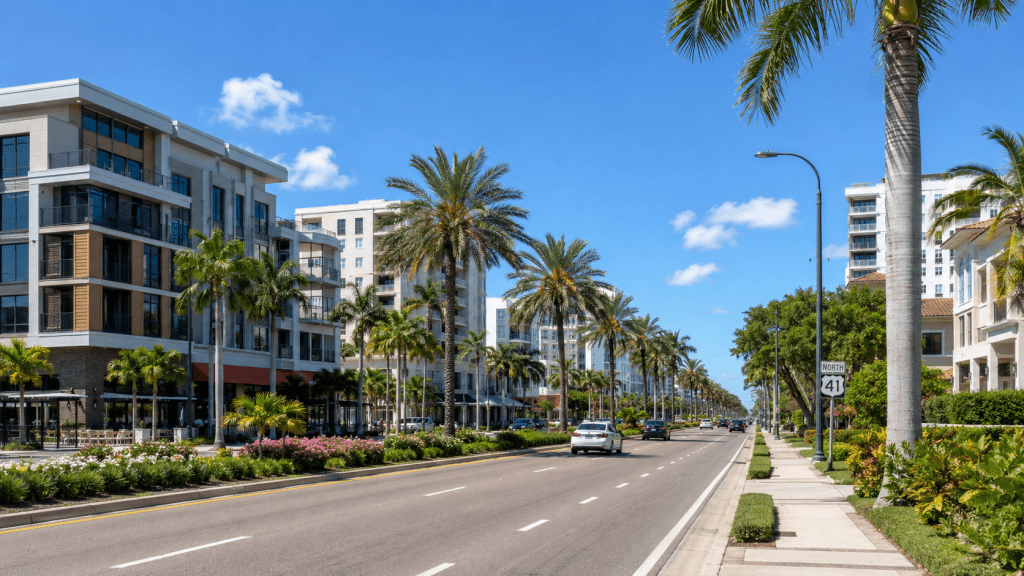
For decades, the North Tamiami Trail corridor in Sarasota was a study in unrealized potential.
Roughly 40,000 vehicles passed through it every day. World-class educational institutions sat directly along its path. Yet the corridor struggled with blight, aging commercial strips, and a fundamental lack of identity.
North Trail Sarasota development is now accelerating — driven by regulatory reform, institutional growth, airport expansion, and an active project pipeline. A convergence of regulatory reform, institutional growth, airport expansion, and active development is transforming Sarasota’s North Trail from an overlooked arterial into one of Southwest Florida’s most compelling land opportunities.
What is the North Trail Overlay District?
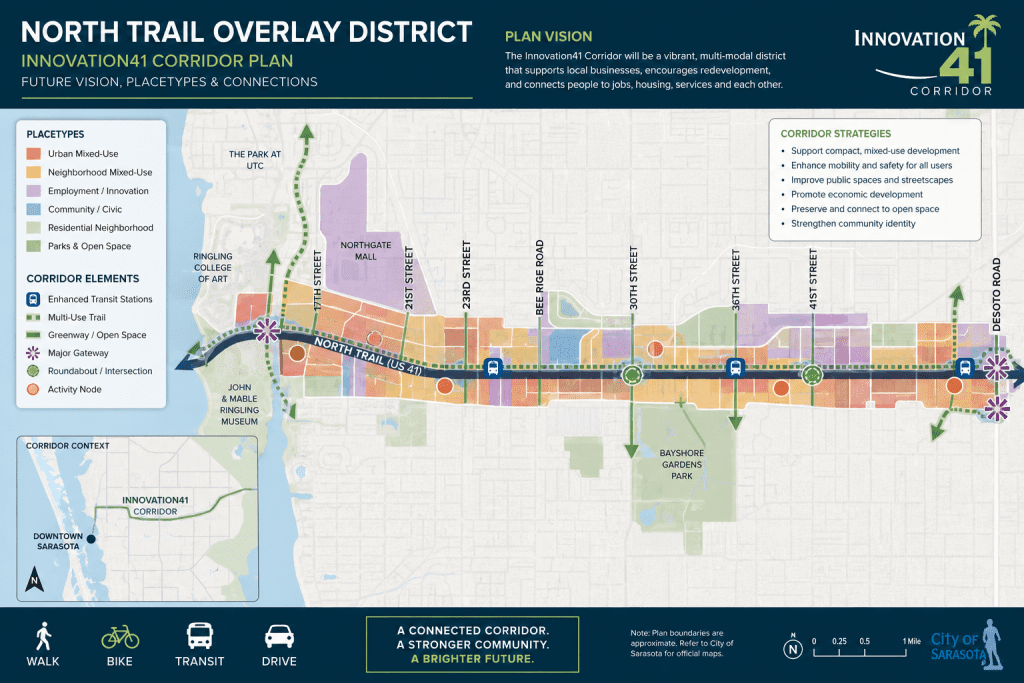
The North Trail Overlay District (NTOD) is a set of forward-looking development standards layered atop the existing Sarasota zoning code. Its purpose is to catalyze mixed-use, pedestrian-friendly redevelopment along this stretch of US-41.
The overlay establishes clear design parameters. Building heights are permitted up to 45 feet. Stringent signage standards apply. Daylight plane protections shield adjacent residential neighborhoods from oversized development.
On the density side, the NTOD’s Urban Mixed-Use 3 designation permits a base density of 35 residential units per acre. That figure can increase to 105 units per acre if at least 15% of the bonus units are priced as attainable housing. For developers evaluating multifamily feasibility on the corridor, those numbers are meaningful.
The vision behind the overlay — articulated through the city’s Innovation41 master planning process — is not to turn US-41 into another downtown main street. It is to remake the cross streets and key focal points where people can gather, linger, and do business. The goal is a corridor with identity — not just throughput.
Three universities that anchor the corridor
What makes the North Trail different from most redevelopment corridors in Florida is what already exists along it.
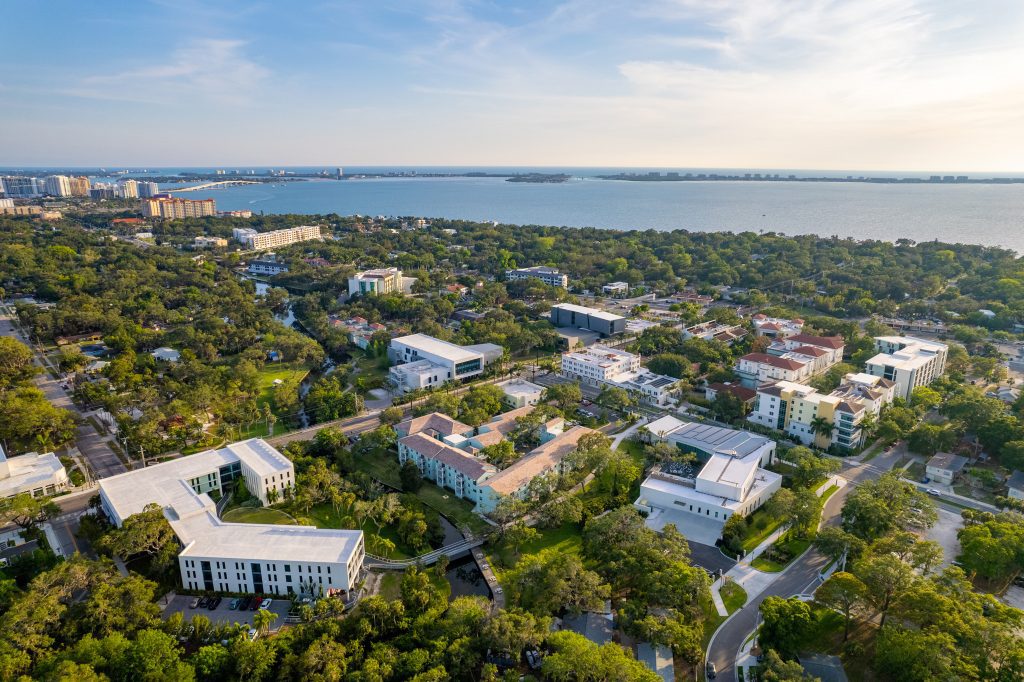
Ringling College of Art and Design sits directly on the Trail. Consistently ranked among the top art and design schools in the world, Ringling draws students and faculty from across the globe. Its presence generates sustained cultural energy and economic activity that extends into the surrounding neighborhood.
New College of Florida — the state’s public honors college — sits adjacent to Sarasota-Bradenton International Airport. It adds an intellectual and residential anchor to the northern end of the corridor.
The University of South Florida Sarasota-Manatee campus rounds out the trio. USF brings workforce development and research capabilities of a major public university to the area.
Together, these three institutions create a built-in ecosystem of students, faculty, and professionals. That population drives sustained demand for housing, retail, services, and creative industry uses — exactly the tenant mix that makes mixed-use development viable.
SRQ: a record-breaking airport next door
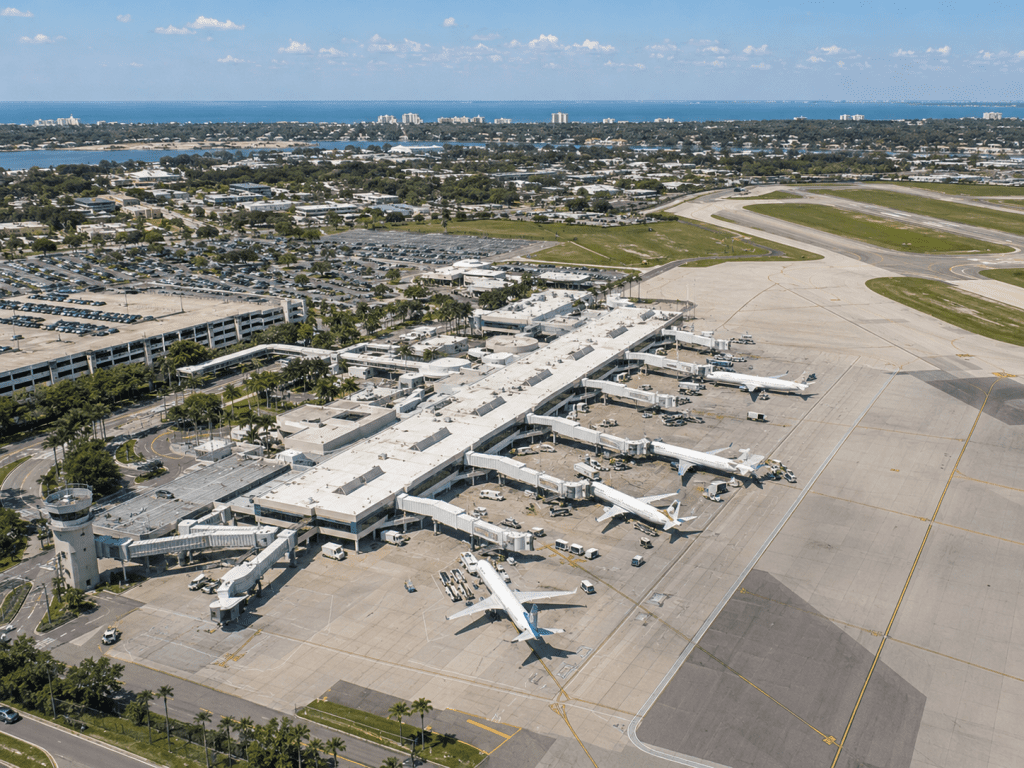
Sarasota-Bradenton International Airport closed 2025 with a record 4,514,781 passengers — a 6.34% increase over 2024. That figure would have seemed unreachable just a decade ago, when the airport handled roughly 1.18 million travelers annually.
The growth has been accompanied by significant infrastructure investment. SRQ opened a new approximately $100 million five-gate Concourse A, completed a new baggage handling system, and built a new ground transportation center. The airport has been widely recognized as one of the fastest-growing and most passenger-friendly airports in the country.
Private aviation is expanding alongside commercial growth. Sheltair Aviation opened its new fixed-base operation at SRQ in November 2025 — a 24-acre complex representing over $40 million in investment, featuring a 10,705-square-foot terminal, 46,000 square feet of new hangar space, and premium general aviation facilities. A 60,000-square-foot maintenance, repair, and overhaul facility is planned for future development on the site.
A new Federal Inspection Station is also under construction adjacent to the Sheltair complex, scheduled to open in spring 2026. When complete, it will enable direct international private aviation arrivals at SRQ.
For nearby landowners and investors, airport growth has historically translated into strong demand for hospitality, office, logistics, and supporting commercial uses. The North Trail corridor sits at the intersection of that demand and the regulatory framework designed to capture it.
The development pipeline — projects already moving
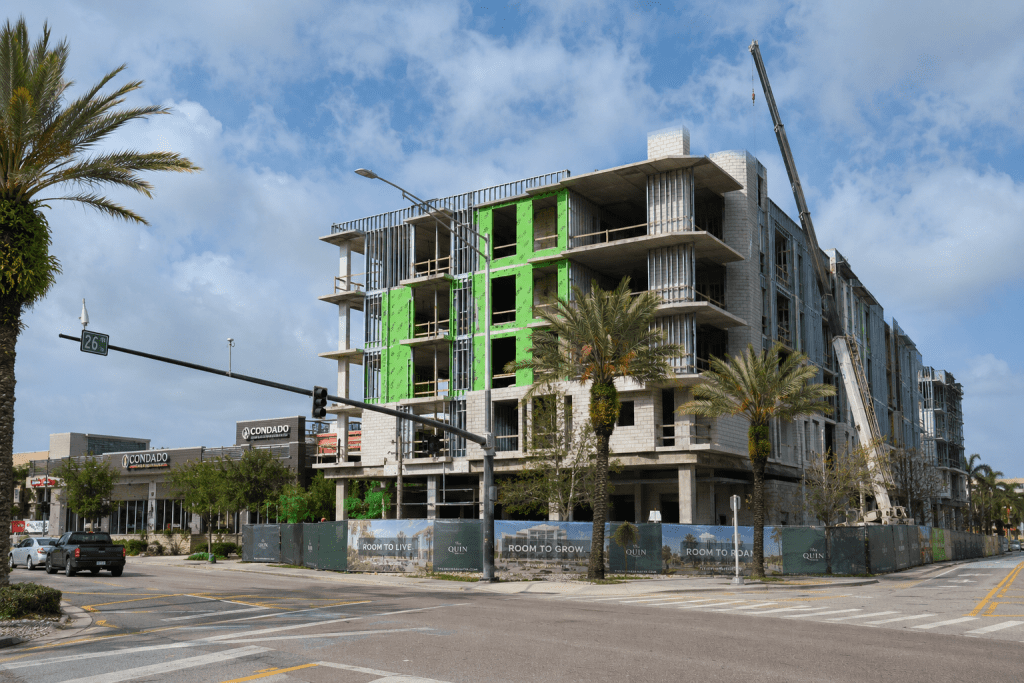
The North Trail is no longer a speculative story. Active projects are in the ground or in the approval pipeline right now.
Three developments illustrate the type of activity the NTOD was designed to generate:
- Saravela: A mixed-use development with 281 residential units and ground-floor retail. The project represents the walkable, higher-density redevelopment the overlay was designed to enable.
- 17th and 18th Street multifamily: A proposed 300-unit multifamily development in the heart of the corridor. Still in the planning process but indicative of the scale of investor interest.
- New Trail Plaza: A 96-unit affordable and attainable housing project that has moved through Sarasota’s Planning Board review process. The project sits within the North Trail Zone District and the NTOD, utilizing the overlay’s attainable housing density bonus.
Eight multifamily developments have been either approved or are under development in the overlay district in recent years. The pipeline is real and growing.
What these projects share is an alignment with the overlay’s intent: walkable density, ground-floor activation, and a residential base that supports the retail and service uses the corridor needs to thrive.
What this means for landowners and investors
The North Trail corridor has the ingredients that historically precede significant land value appreciation: regulatory enablement, institutional demand anchors, infrastructure investment, and active deal flow.
For landowners along or near the corridor, the question is no longer whether change is coming. The question is whether your property is positioned to participate in it — and whether the current moment is the right time to act.
Properties sitting within or adjacent to the NTOD carry entitlement potential that may not be fully reflected in current valuations.
For developers and investors, the overlay’s density bonus structure — up to 105 units per acre with attainable housing thresholds — creates a viable financial model for mixed-use multifamily that was not available under the previous code. Knowing what developers look for before making an offer helps sellers position their properties accordingly.
If you own land along the North Trail or in the broader Sarasota corridor, [ANCHOR: our Southwest Florida land advisory team → /brokers-contact/] can help you understand what the current market means for your property. You can also view available land listings across Southwest Florida.
Own land in the Sarasota area or evaluating acquisitions along the North Trail corridor? Contact Eshenbaugh Land Company for a confidential conversation with Josh Streitmatter or our Southwest Florida team.