

Tampa, FL — October 9, 2026 — Written by Nick Cannella
Selling inherited land in Florida is often simpler than heirs expect: Florida has no state estate or inheritance tax, and inherited property receives a ‘stepped-up’ cost basis to its fair market value on the date of death — which usually means little or no capital gains tax if you sell soon after inheriting.
Inheriting land can arrive at an emotional time, and the decisions that follow — sell, hold, or develop — carry real financial weight. Understanding the tax picture and the practical steps up front makes those decisions far less stressful.
Does Florida tax inherited land?
No. Florida has no state estate tax and no state inheritance tax. Heirs who inherit Florida land do not owe a state tax simply for receiving it. At the federal level, an estate tax can apply only to very large estates — the federal estate tax exemption is $15 million per individual in 2026 under the One Big Beautiful Bill Act — so the vast majority of inherited land passes with no federal estate tax either.
The stepped-up basis: the most important rule for heirs
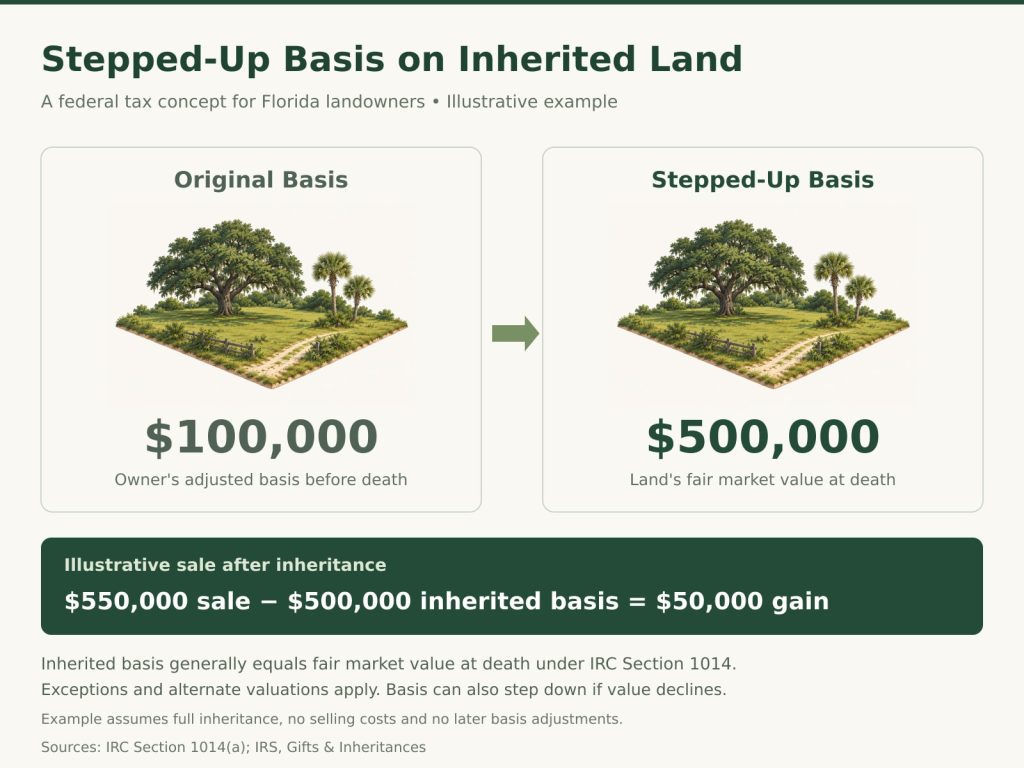
The single most valuable tax rule for inherited property is the stepped-up basis. Under Internal Revenue Code Section 1014, when you inherit land, your cost basis is ‘stepped up’ to the property’s fair market value on the date of the previous owner’s death — not what they originally paid for it.
Here is why that matters. Suppose a parent bought 40 acres decades ago for $50,000, and it was worth $600,000 on the date they passed. Your basis becomes $600,000. If you sell shortly afterward for $610,000, your taxable capital gain is only $10,000 — not the $560,000 of appreciation that built up over the parent’s lifetime. That built-up gain is effectively erased for tax purposes.
Documentary stamp tax and inherited transfers
Florida charges a documentary stamp tax on most transfers of real property, but transfers by inheritance or through a will are generally exempt because there is no purchase consideration. When heirs later sell the land to a buyer, the documentary stamp tax then applies to that sale in the normal way.
Steps to selling inherited land in Florida
- Confirm clear title and ownership. If the property passed through probate, make sure the estate has been properly administered and title is clear. Multiple heirs will all need to be on the same page.
- Establish the date-of-death value. A Broker Opinion of Value or appraisal as of the date of death documents your stepped-up basis and supports your tax position.
- Understand the land’s real market position. Zoning, access, utilities, and development potential drive value far more than acreage alone.
- Decide among co-heirs. If several people inherited together, agree on whether to sell, hold, or divide before going to market.
- Go to market strategically. A land broker can position the property to the right buyer pool and help you weigh price against speed and certainty.
Selling with multiple heirs
Land is frequently inherited by more than one person — siblings, cousins, or an extended family. All co-owners generally must agree to a sale, and disagreements over price or timing are common. A neutral, market-based valuation helps align expectations, and a broker experienced with family-owned land can keep the process moving while respecting everyone’s interests.
Should you sell or hold inherited land?
There is no universal answer. Selling soon after inheriting captures the stepped-up basis with little or no capital gains tax. Holding may make sense if the area is growing and values are rising — but remember that gains accruing after the date of death are taxable when you eventually sell. Property taxes, maintenance, and liability also continue while you hold. Understanding both the value and the carrying costs helps you decide.
For the federal rules on determining basis of inherited property, see the IRS guidance: IRS Publication 551, Basis of Assets.
Inherited land and not sure where to start? Request a confidential Broker Opinion of Value at https://www.thedirtdog.com/contact/ to understand your property’s value and options.
This article is general information, not tax or legal advice. Consult a CPA and an estate attorney about your specific situation.