

Tampa, FL — October 19, 2026 — Written by Nick Cannella
Gifting land to family in Florida is usually straightforward: Florida has no state gift tax, an unencumbered gift deed typically owes no documentary stamp tax, and you can give up to $19,000 per recipient in 2026 without touching your federal lifetime exemption. But the choice between gifting now, selling, or leaving land through your estate has real tax consequences — especially around cost basis.
Many Florida landowners want to keep property in the family — passing acreage to children, grandchildren, or siblings. Doing it well means understanding not just how to transfer title, but how the timing and method affect everyone’s taxes down the road.
Is there a gift tax when gifting land to family in Florida?
Florida has no state gift tax. The only gift tax is federal, and most families never actually pay it. Two federal numbers matter in 2026:
- Annual exclusion — $19,000 per recipient per year ($38,000 for a married couple giving together). Gifts under this amount require no gift tax return at all.
- Lifetime exemption — $15 million per individual in 2026 under the One Big Beautiful Bill Act. Gifts above the annual exclusion simply reduce this lifetime amount; you owe no out-of-pocket gift tax until you exceed it.
For a gift of land worth more than $19,000, you (the giver) file IRS Form 709 to report it, but in almost all cases no tax is due — the excess just counts against your $15 million lifetime exemption.
Documentary stamp tax on a gift deed
Florida charges documentary stamp tax on deeds at $0.70 per $100 of consideration ($0.60 in Miami-Dade). For a true gift of unencumbered land — no mortgage, given out of love and affection — there is generally no consideration, so little or no documentary stamp tax is due. However, if the land carries a mortgage that the recipient takes subject to, documentary stamp tax is generally owed on the outstanding balance being assumed. This catches many families by surprise, so confirm the mortgage situation before you transfer.
The basis trap: gifting vs. inheriting
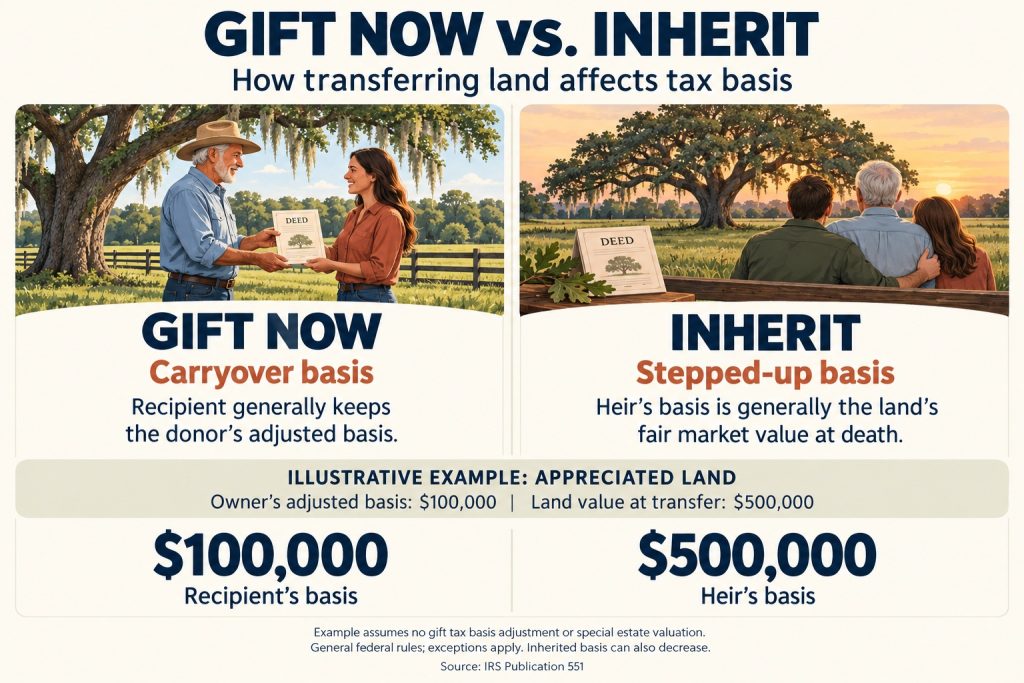
This is the most important consideration, and it is easy to get wrong. When you gift land during your lifetime, the recipient takes your original cost basis (a ‘carryover basis’). When land is inherited instead, the heir gets a stepped-up basis to fair market value at your death — which can erase decades of capital gains.
An example makes the difference clear. Say you bought 20 acres for $40,000 and it is now worth $400,000:
- If you gift it now, your child takes your $40,000 basis. If they later sell for $400,000, they face capital gains tax on $360,000.
- If they inherit it instead, their basis steps up to $400,000. Selling at $400,000 produces little or no taxable gain.
That does not mean gifting is wrong — there are good reasons to transfer during your lifetime (estate planning, removing future appreciation from your estate, helping family sooner). But the basis difference should be part of the decision.
Common ways to transfer land to family
- Outright gift deed — Transfer title now via a properly prepared and recorded deed. Simple, but triggers carryover basis and gives up your control.
- Sale to a family member — Selling (even at a discount) can make sense in some situations, though a below-market sale can be treated partly as a gift.
- Leaving it through your estate or a trust — Passing land at death preserves the stepped-up basis; a trust or a life estate can control timing and avoid probate.
- Lady bird (enhanced life estate) deed — A Florida tool that lets you keep full control and use during your life, with the property passing automatically at death and preserving stepped-up basis.
Each option carries different tax, control, and Medicaid-planning implications, so this is a conversation to have with an estate attorney and a CPA.
Know your land’s value before you transfer
Whichever path you choose, you need an accurate picture of the land’s value — for the gift tax return, for the basis calculation, and for fair treatment among family members. A Broker Opinion of Value gives you a defensible, market-based number before you file anything or divide anything.
For the federal gift tax rules and Form 709, see the IRS— Frequently Asked Questions on Gift Taxes.
Planning to keep land in the family and need a value to work from? Request a confidential Broker Opinion of Value at https://www.thedirtdog.com/contact/.
This article is general information, not tax or legal advice. Consult an estate attorney and a CPA about your specific situation.