
Tampa, FL — October 6, 2026 — Written by Nick Cannella
If you sell land in Florida, capital gains tax when selling land in Florida is owed to the federal government only — Florida has no state capital gains or personal income tax. Your federal bill depends on how long you held the property and your income, with long-term rates of 0%, 15%, or 20%, plus a possible 3.8% net investment income tax.
That single distinction — no state-level tax — is one of the reasons Florida land remains attractive to investors and long-term owners. But the federal side still matters, and understanding how it is calculated before you sell can save you from surprises at closing and help you plan a sale that keeps more money in your pocket.
Does Florida have a state capital gains tax?
No. Florida does not impose a state capital gains tax or a state personal income tax. The Florida Constitution (Article VII, Section 5) prohibits a personal income tax, and capital gains on the sale of land are treated as income at the federal level. That means when you sell land in Florida, the only capital gains tax you owe is federal.
This is a genuine advantage compared with high-tax states. A landowner selling comparable property in California or New York could owe state income tax on the gain in addition to the federal tax. In Florida, that state layer simply does not exist.
How capital gains tax on land is calculated
Your capital gain is not the same as your sale price. The gain is what is left after you subtract your cost basis and selling expenses:
Capital gain = Sale price − Adjusted cost basis − Selling expenses
A few terms worth understanding:
- Cost basis is generally what you originally paid for the land, plus certain improvements (clearing, fill, permitting, road or utility work). Keeping records of these costs raises your basis and lowers your taxable gain.
- Selling expenses include real estate commissions, closing costs, documentary stamp taxes you pay, and other costs directly tied to the sale.
- Holding period determines whether the gain is taxed at long-term or short-term rates.
Long-term vs. short-term capital gains
The length of time you owned the land before selling is the single biggest factor in your federal rate:
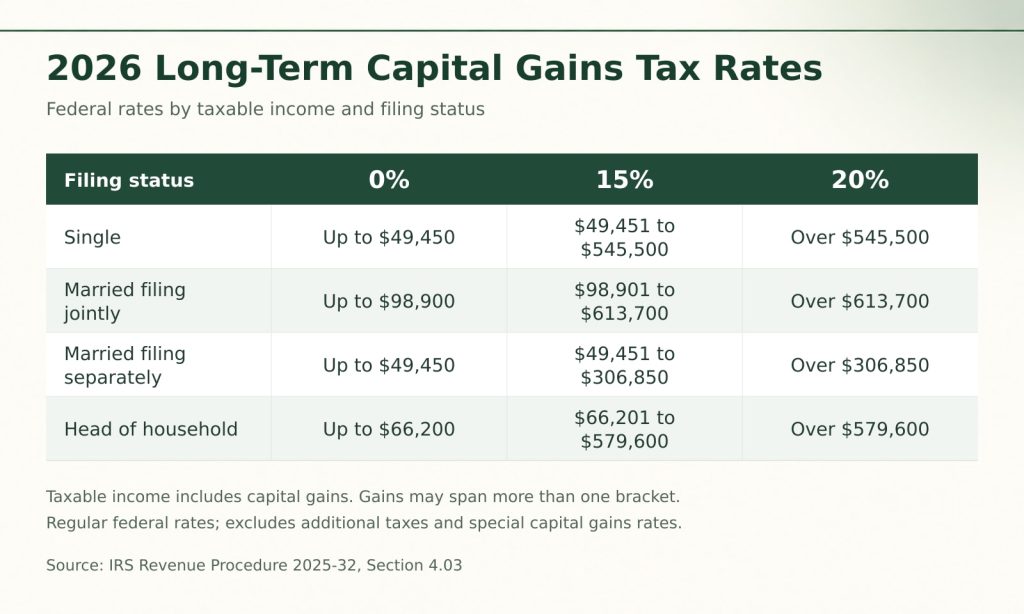
- Long-term (held more than one year): taxed at preferential rates of 0%, 15%, or 20%, depending on your taxable income.
- Short-term (held one year or less): taxed as ordinary income at rates up to 37%.
For 2026, most landowners fall into the 15% long-term bracket. Higher-income sellers may reach 20%, and some lower-income sellers qualify for the 0% rate. Because the difference between short-term and long-term treatment can be enormous, timing a sale even a few weeks past the one-year mark can matter.
The 3.8% net investment income tax
Higher-income sellers should also be aware of the net investment income tax (NIIT), an additional 3.8% federal tax that can apply to capital gains once your modified adjusted gross income exceeds certain thresholds. For a large land sale, the NIIT can effectively push a 20% long-term rate to 23.8%. A tax professional can tell you whether it applies to your situation.
Strategies that may reduce capital gains tax on a land sale
Every landowner’s situation is different, but several well-established strategies can reduce or defer the federal tax on a land sale:
- 1031 exchange — Defer the entire gain by reinvesting the proceeds into another qualifying investment property within the IRS timelines. This is one of the most powerful tools available to land investors.
- Installment sale — Spread the gain (and the tax) over several years by receiving payments over time rather than in a single lump sum, which can keep you in a lower bracket.
- Track and document your basis — Improvements, surveys, and permitting costs raise your basis and directly reduce your taxable gain.
- Time the sale — Holding past the one-year mark converts a short-term gain into a long-term one; selling in a lower-income year can lower your bracket.
- Offset with losses — Capital losses elsewhere in your portfolio can offset land gains.
A knowledgeable land broker can help you understand how these choices interact with pricing, timing, and buyer demand — and a good Broker Opinion of Value gives you the value picture before you make any tax decision.
Plan the tax side before you sell
Capital gains tax when selling land in Florida is entirely a federal matter, but that does not make it simple. Your holding period, your basis, your income, and the way you structure the deal all shape the final number. The best time to think about it is before you go to market — not after you have accepted an offer. Eshenbaugh Land Company works with landowners across Florida to evaluate their property and time a sale strategically. For specific tax advice, always consult a qualified CPA or tax attorney.
For the federal rules, see the IRS overview of capital gains and losses.
Thinking about selling and want to understand your value and options first? Request a confidential Broker Opinion of Value at https://www.thedirtdog.com/contact/.