
Tampa, FL, August 4th, 2026–Written by Nick Cannella
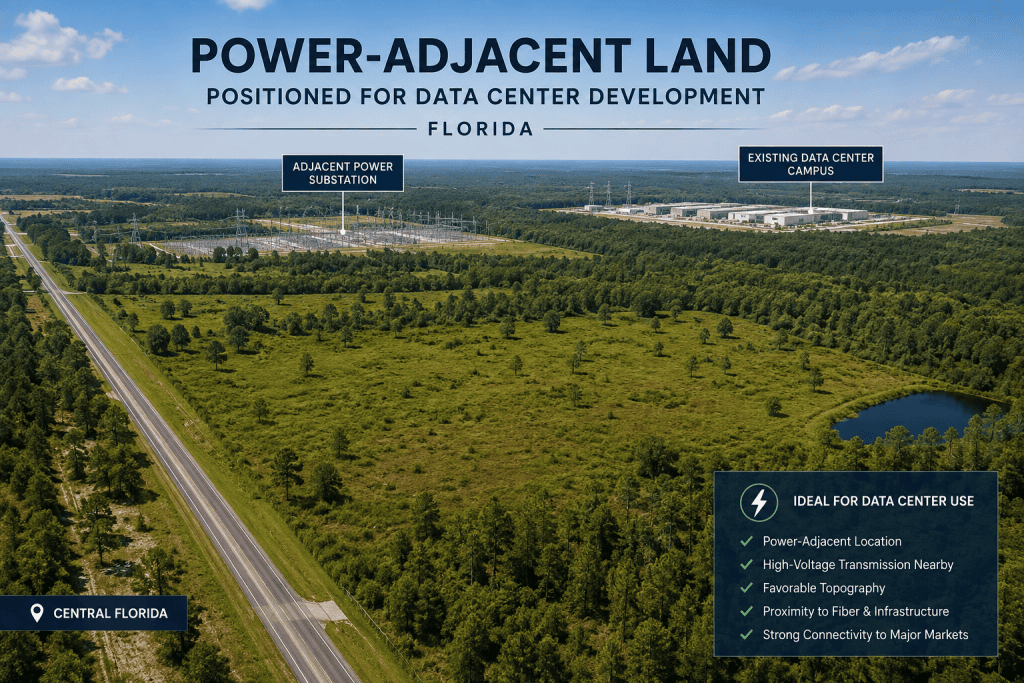
Data centers in Florida are now one of the most aggressive buyers of land in the state — and for owners of large, power-adjacent parcels, that demand represents one of the most compelling opportunities the market has seen in years.
Driven by the explosive growth of artificial intelligence and cloud computing, technology firms and specialized developers are scouring the state for large, well-positioned tracts. In our work across Southwest and Central Florida, we are seeing this demand surface in places the map overlooked a year ago.
This post explains what is driving the wave, what makes a parcel attractive to these buyers, and what landowners should understand before they respond to an offer.
Why data centers are buying land in Florida now
The momentum is unmistakable. Industry trackers count billions of dollars in announced data center projects across Florida, representing tens of millions of square feet of proposed space.
A single large campus can bring hundreds of millions — sometimes billions — of dollars in capital investment, a substantial expansion of the local tax base, and hundreds of skilled jobs. And it does so on land uses that generate little traffic and operate quietly around the clock.
As established hubs like Northern Virginia hit power and land constraints, the industry is diversifying geographically. Florida, with its expanding power grid, business-friendly climate, and strong population growth, has become a fast-rising contender.
The real constraint is power, not land
Here is the part most landowners miss: the binding constraint on data center growth is not land — it is electricity.
A single hyperscale campus can require as much power as a small city. Developers are running into grid capacity limits and long waits for the gas turbines and transmission infrastructure needed to energize big projects.
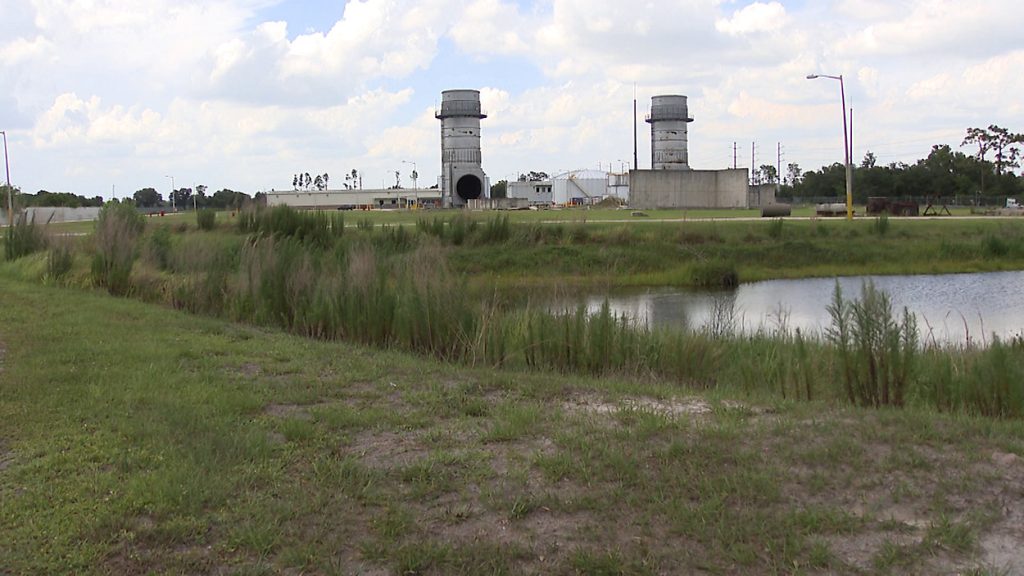
That flips the usual land-value playbook. The most valuable sites are not simply well-located — they are near substations and high-capacity transmission lines, ideally with access to natural gas for on-site generation and water for cooling. Former mining sites, decommissioned power plants, and large rural holdings — long considered difficult to reposition — are precisely the flat, infrastructure-adjacent parcels these projects seek.
Where the activity is concentrated
Data center demand in Florida is clustering where land and power capacity meet.
In DeSoto County, a developer is assembling roughly 1,300 acres on a former power-plant site for a major campus, drawing on the Florida Gas Transmission pipeline for power. In Polk County, the city of Fort Meade approved a developer agreement for what could become the state’s first hyperscale campus. Additional proposals have surfaced across Palm Beach, St. Lucie, Citrus, Martin, and Nassau counties.
Rural, power-rich counties are seeing the largest proposals precisely because that is where the land and the potential power capacity exist. For owners of large tracts in these areas, the calculus has changed.
What data center buyers look for in a site
Not every large parcel qualifies. In evaluating land for these buyers, a few fundamentals matter most:
- Power: Substantial power access — proximity to substations and high-capacity transmission, or a path to it.
- Fiber: Proximity to fiber routes for connectivity.
- Water: An adequate, permittable water supply for cooling.
- Land quality: Flat, developable, well-drained ground with minimal wetland or environmental constraints.
- Political support: Local government and community support — increasingly the deciding factor.
Understanding what developers look for before making an offer applies directly here — data center buyers underwrite risk the same way, just with power at the center of the analysis.
The community-opposition factor landowners should weigh
Data center projects do not always move smoothly. Many face organized community opposition, most often over water use and strain on the electrical grid.
Florida’s 2026 legislative session produced new guardrails. SB 484, effective July 1, 2026, prohibits shifting data center power costs onto residential ratepayers, requires specific water-permitting review, and preserves local zoning authority. For landowners, the takeaway is that a data center sale is rarely a quiet transaction — it runs through public hearings, and community sentiment can shape whether a project, and your sale, moves forward.
A parcel with power capacity confirmed and local support secured is worth substantially more than one where those questions are still open.
What this means for landowners
If you own a large, power-adjacent parcel in Florida — particularly near a substation, transmission corridor, or gas pipeline — you may hold exactly what this new class of buyer is chasing.
These buyers are willing to pay premiums few other uses can match. But the value hinges on fundamentals most owners have never had reason to evaluate: power capacity, water availability, and local support. Engaging early, before you are approached with an offer, gives you time to understand what your land is actually worth to this market.
If you own land you think might fit this profile, our land advisory team can help you assess its power and infrastructure position before you respond to any offer. You can also view available land listings across Florida.
As AI infrastructure continues its rapid expansion, competition for suitable Florida sites will intensify — and the value of well-located, power-adjacent land will follow. For owners who recognize the opportunity and move decisively, the data center wave may be one of the defining land plays of the coming decade.
Own a large, power-adjacent parcel? Contact Eshenbaugh Land Company to understand what it’s worth to this new buyer.