
Tampa, FL, June 9th, 2026–Written by Nick Cannella
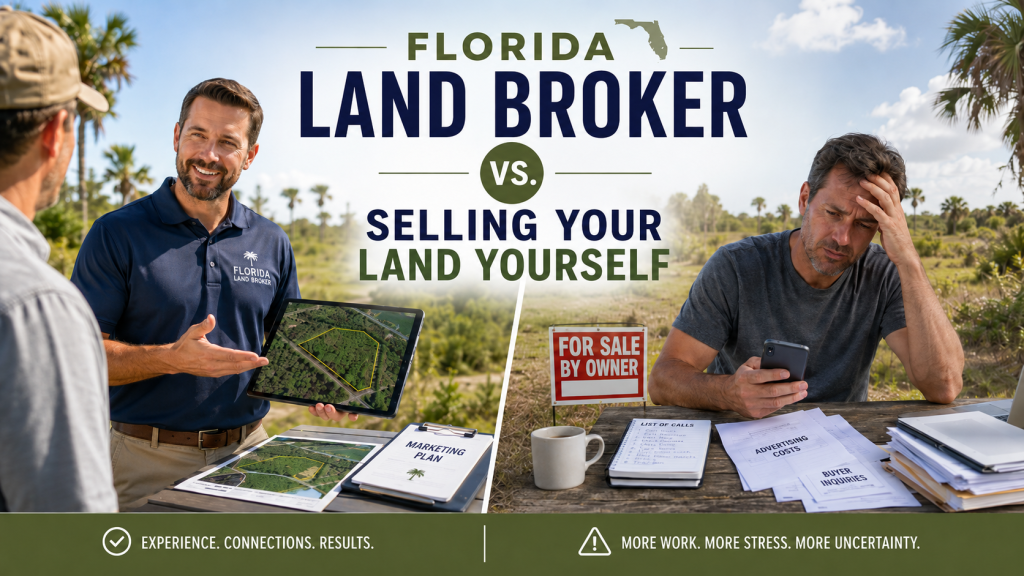
The question comes up more than you might expect: is it worth hiring a land broker, or can a landowner handle the sale on their own?
It is a reasonable question. Brokerage fees are real. And in a market where land values have appreciated significantly, some landowners look at the commission and wonder if they can just find a buyer themselves.
Here is an honest answer — including the cases where selling yourself might make sense, and the more common cases where it costs landowners more than the commission they were trying to avoid.
What “selling yourself” actually means in land
Selling residential property without an agent is straightforward compared to land. Most residential buyers are searching on Zillow or Realtor.com. The comparable sales data is relatively accessible. Financing is standardized.
Land is a different market. The buyers for large tracts — homebuilders, developers, institutional land funds — do not browse public listing portals the way a homebuyer does. They have acquisition teams, relationships with brokers they trust, and internal pipelines of properties they are already tracking. If your land is not in front of those buyers, it is not in front of the market.
Selling yourself typically means: listing on a few websites, accepting calls from whoever finds you, and negotiating a contract with limited knowledge of what comparable land has actually sold for, what the buyer is underwriting, or what protections you should have in the contract.
Where brokers add value: the honest version
Not every broker adds the same value. A general commercial agent who occasionally handles land is a different resource than a firm that has spent decades exclusively in the Florida land market. That distinction matters more than most landowners realize before they are under contract and discovering what they did not know.
Market knowledge and pricing accuracy
Land valuation is not straightforward. How developers and builders price land involves a residual land value analysis — working backward from what the finished project would sell or lease for, then backing out construction costs, carrying costs, profit margin, and entitlement risk. A landowner pricing their own property without this framework almost always either underprices (leaving money on the table) or overprices (and sits on the market for months while the right buyer moves on).
Access to the actual buyer pool
An experienced land brokerage firm has relationships with the acquisition teams at regional and national builders, land funds, and developer groups active in Florida. Those buyers are not passively browsing listings — they are calling brokers they know and trust when they have capital to deploy. Being in that conversation requires access that most individual landowners simply do not have.
Contract structure and protection
Land contracts in Florida are not standardized the way residential purchase agreements are. The due diligence period, earnest money structure, extension rights, entitlement contingencies, and participation clauses can all significantly affect the economics and risk profile of a deal. Developers have attorneys who negotiate land contracts routinely. Most landowners do not.
Transaction management through due diligence
When a buyer requests a 90-day due diligence extension, how do you respond? When environmental testing comes back with findings, how do you evaluate whether they are deal-killers or pricing adjustments? When a buyer requests seller financing as a condition of closing, do you know what the market rate looks like for that structure? These are the moments where an experienced broker prevents transactions from quietly falling apart.
When selling yourself might make sense
There are situations where FSBO (for sale by owner) land transactions work. They are not common, but they exist:
You already have a known buyer — a neighbor, a longtime adjacent landowner, or an end user who has approached you directly. The relationship is established and both parties have agreed on price without a formal marketing process.
The property is small, simple, and in a location where buyer demand is easy to reach through public listing platforms — a rural recreational parcel, a small infill lot in a rural county.
You have significant experience in real estate transactions and understand the contract, due diligence, and closing process from the sell side.
If none of those conditions apply, the FSBO path tends to cost more than the commission it saves.
The hidden cost most landowners underestimate
Brokerage fees in land typically run 3% to 6% of the sale price, depending on deal size and structure. That is a real number — but it needs to be weighed against what a professional marketing process actually produces.
In our experience, properly marketed land — presented to the right buyers at the right time, with accurate positioning and competitive tension in the offer process — regularly produces sale prices that exceed what a landowner would have accepted from the first buyer who called them. The difference is often larger than the commission.
The landowner who accepts the first unsolicited offer they receive — often at 70 to 80 cents on the dollar compared to a properly marketed price — has effectively paid a larger cost than any commission, without receiving the corresponding service.
What to look for in a land broker
Not all brokers specialize in land. A generalist commercial broker who occasionally handles land is not the same as a firm that has spent its entire career in this niche. When evaluating a land broker in Florida, the right questions are:
How many land transactions — not commercial real estate broadly — have they closed in your county or submarket in the past three years? Do they have relationships with the active acquisition teams for the builders and developers currently buying in your area? Do they hold ALC (Accredited Land Consultant) or CCIM designations — credentials that indicate specialized land and investment real estate training? Can they show you their analysis of how your land would be priced by a developer, not just what comparable raw land sold for?
If you want to understand exactly what sets a land broker apart from a traditional real estate agent, our breakdown of land brokerage vs. real estate brokerage covers the key differences and why they matter when selling Florida land.
You can learn more about our land brokerage approach and how we work with land sellers across Tampa Bay and Central Florida. If you are ready to talk about your property, contact our advisory team.