
Tampa, FL, June 12th, 2026 — Written by Nick Cannella
Two landowners in the same county own similar parcels. Same acreage, same access, similar location.
One is worth $15,000 per acre. The other is worth $60,000 per acre.
The difference often comes down to Florida’s Comprehensive Plan land use designation — one document that determines what your land can become.
Understanding how Florida’s Comprehensive Plan works is one of the most practical things a landowner or developer can do. It determines what your land can become — and what it is worth today.
What is a Comprehensive Plan?
Every Florida county and municipality is required by state law to adopt a Comprehensive Plan.
The Comprehensive Plan — often called the “Comp Plan” — is a long-range policy document that guides how land in a jurisdiction is developed over time. It is required under Florida Statutes Chapter 163, which mandates that local governments plan for growth in a coordinated, consistent way.
The Comp Plan is not zoning. It operates at a higher level. It establishes what types of uses are possible on land across the jurisdiction — residential, commercial, industrial, agricultural, conservation, and mixed-use. Zoning then implements those designations at the parcel level.
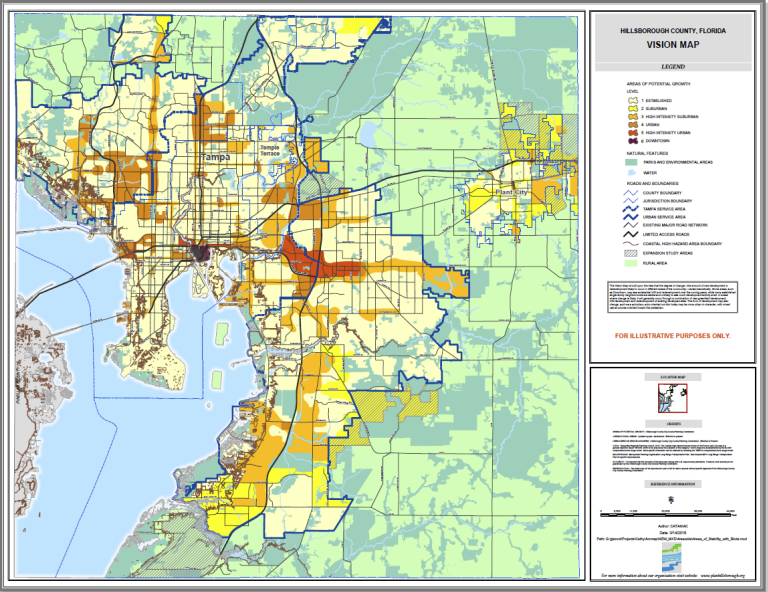
The most important component of the Comp Plan for landowners is the Future Land Use Map.
The Future Land Use Map — the document that determines your land’s potential
The Future Land Use Map (FLUM) assigns every parcel of land in a jurisdiction a future land use designation.
Common designations include Residential Low, Residential Medium, Residential High, Commercial, Industrial, Mixed Use, Agricultural, and Conservation. Each designation carries a maximum density or intensity — measured in dwelling units per acre for residential, or floor area ratio for commercial and industrial.
The designation on the FLUM determines the ceiling of what can be built on your land. A parcel designated Agricultural with a density of one unit per ten acres can support very little residential development. A parcel designated Residential High at twelve units per acre supports a much more intensive — and valuable — development program. This is why the FLUM is the first document experienced developers and advisors review when evaluating a property.
Why Comp Plan designations affect land value directly
Developers underwrite land based on what they can build.
A parcel designated for high-density residential supports more units. More units means more revenue from the finished project. More revenue supports a higher land price. The math flows directly from the FLUM designation.
Conversely, a parcel with a restrictive designation — agricultural or conservation, for example — limits the development program. Buyers will either price that restriction into their offer or move on to a more permissive site.
This dynamic is especially relevant in fast-growth markets. Land on the urban fringe in Pasco, Hillsborough, Polk, and Osceola counties often carries agricultural designations that no longer reflect the market reality of surrounding development. The gap between the current designation and what the market demands is where landowner opportunity lives — and where entitlement risk also concentrates.
Comprehensive Plan amendments — changing what your land can become
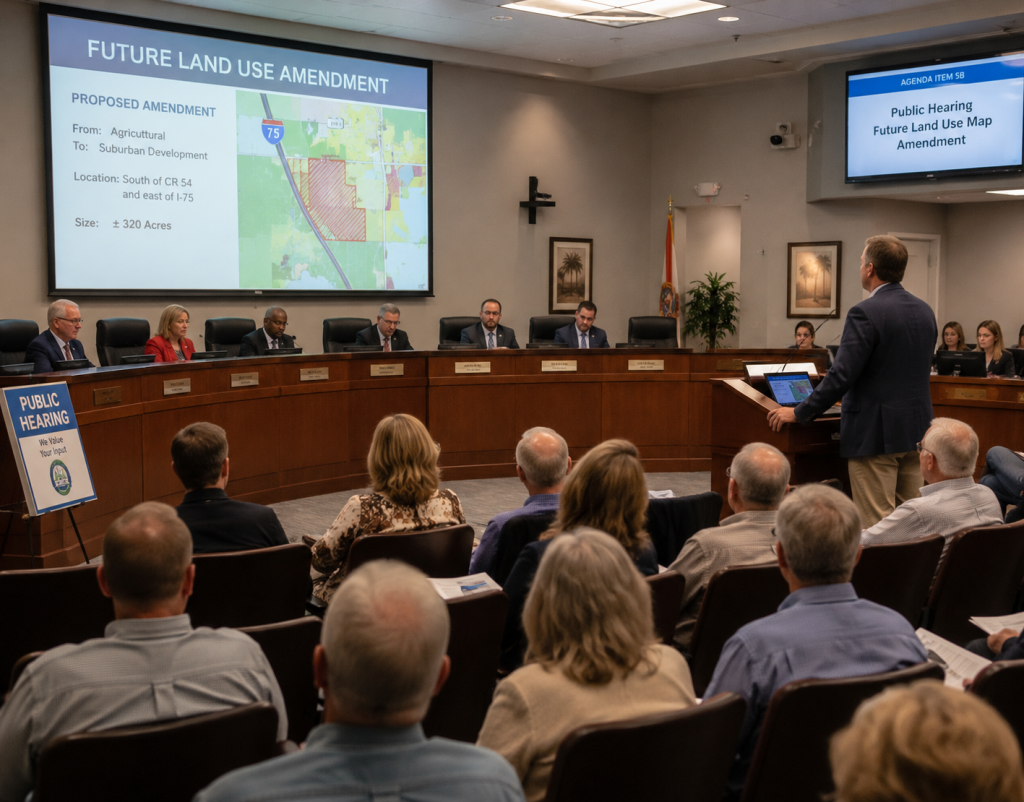
A Comprehensive Plan amendment (sometimes called a “Comp Plan amendment” or “large-scale amendment”) is the process of changing a parcel’s future land use designation.
This is the first step in entitling land for a new use. Before a parcel can be rezoned for residential development, the FLUM designation must support that use. If it does not, the landowner or developer must apply for an amendment.
Comp Plan amendments in Florida go through a structured review process.
- The applicant submits an amendment application to the local government.
- The local planning staff reviews the request for consistency with the Comp Plan’s goals, policies, and data.
- A public hearing is held before the local planning board, followed by a second hearing before the county commission or city council.
- Large-scale amendments (generally those affecting ten or more acres — thresholds vary by jurisdiction) are transmitted to the Florida Department of Commerce (formerly the Department of Economic Opportunity) for state review before final adoption.
- Following state review, the local government holds a second adoption hearing.
The full process can take 12 to 24 months for a straightforward large-scale amendment. More complex amendments — those involving significant infrastructure questions, environmental concerns, or community opposition — can take longer.
Concurrency — the infrastructure requirement built into the Comp Plan
Florida’s Comp Plan system includes a concurrency requirement.
Concurrency means that the infrastructure needed to support a development — roads, schools, water, sewer, parks — must be available at the time of development, or be committed to be available within a defined period. If infrastructure capacity does not exist, the development cannot proceed regardless of what the FLUM designation allows.
In practical terms, concurrency is why some well-located land sits undeveloped for years. The designation may support residential development, but the road network, school capacity, or sewer system is not adequate to support it yet. Infrastructure timing is often the limiting factor — not the Comp Plan designation itself.
This is one reason why proximity to planned FDOT projects, county capital improvement programs, and utility expansion plans matters so much to land values in Florida.
What landowners should know before making any decisions
The first thing to understand about your land is its current FLUM designation.
This is public information. Every Florida county publishes its Future Land Use Map and Comprehensive Plan online. You can look up your parcel’s designation, the maximum density or intensity it supports, and the goals and policies that govern amendments in your area.
The second thing to understand is the gap between that designation and the market.
If your land is designated Agricultural but sits adjacent to residential development, the gap between current designation and market potential may represent significant value — if the amendment process can be completed successfully. That “if” carries real risk, cost, and time.
Most landowners benefit from a conversation with an experienced land advisor before deciding whether to pursue a Comp Plan amendment, sell the land in its current state, or wait for market conditions to make the economics more compelling.
For a step-by-step walkthrough of the entitlement process that follows a Comp Plan amendment, see how long it takes to entitle land in Florida. To talk through your specific property and what the Comp Plan means for its value, contact our land advisory team.
Want to know what your land’s Comprehensive Plan designation means for its value and development potential? Contact Eshenbaugh Land Company for a confidential review.