
Tampa, FL, June 17th, 2026–Written by Josh Streitmatter
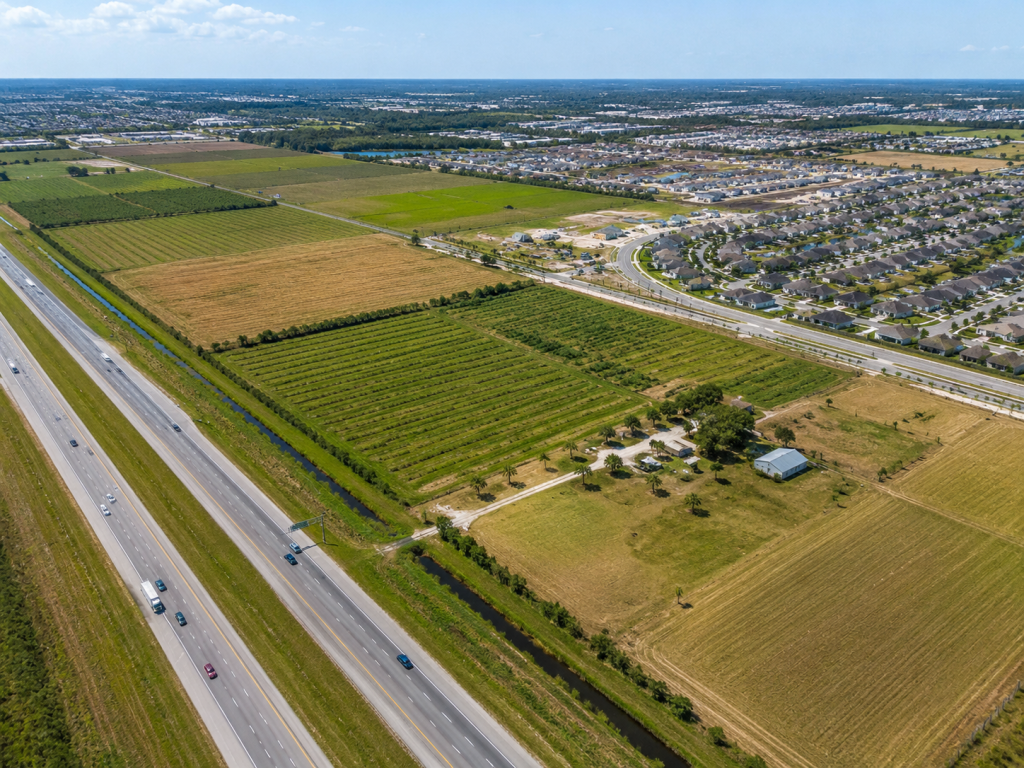
SB 686 Florida — signed into law by Governor Ron DeSantis in April 2026 — creates a faster approval path for agricultural landowners whose property is surrounded by existing development. Rather than going through the traditional comprehensive plan amendment process, qualifying properties can apply directly to the local government for development certification.
Governor Ron DeSantis signed SB 686 into law on April 21, 2026 — now codified as Chapter 2026-34. The law amends Florida Statutes §§ 163.3162 and 163.3164.
For Florida landowners and developers, this matters. It creates a defined window of opportunity — but that window closes January 1, 2028, unless the Legislature acts to extend it.
What problem does SB 686 solve?
Florida’s agricultural land is disappearing. Population growth has pushed development into areas that were once rural, leaving pockets of farmland surrounded by subdivisions, commercial centers, and infrastructure.
Under existing law, a landowner in that position still had to go through the full comprehensive plan amendment process to pursue development. That process can take 12 to 24 months or more. It requires public hearings, state agency review, and a favorable vote from the county commission — with no guarantee of approval.
SB 686 recognizes that farmland already encircled by development is not the same as genuinely rural land at the edge of the urban fringe. It creates a separate, faster pathway for those properties — one that reflects what has already happened around them.
For more context on how the traditional approval process works, see how Florida’s Comprehensive Plan works and why it matters for your land.
What qualifies as an agricultural enclave under SB 686?
Not every agricultural parcel qualifies. The law defines an “agricultural enclave” with specific criteria that must all be met.
- Unincorporated: The parcel must be outside city limits. Incorporated parcels within a municipality do not qualify.
- Undeveloped: The land must currently be undeveloped.
- Single owner: The parcel must be under single ownership.
- 1,280 acres or less: The parcel cannot exceed 1,280 acres in total area.
- Largely surrounded by existing development: The property must be substantially surrounded by already-developed land.
- County population cap: The law applies only in counties with populations of 1.75 million or less. Most Florida counties fall below that threshold. Miami-Dade and Broward are the primary exceptions.
The applicant must also demonstrate that surrounding properties already permit similar or greater density or intensity of development. This is the foundational comparison the local government uses to evaluate the application.
Note: The qualifying criteria are defined in Florida Statutes § 163.3164(4), as amended by SB 686. Always verify your parcel’s eligibility with a qualified land attorney or advisor before relying on this pathway.
How the application process works
The process under SB 686 is significantly faster than a traditional comprehensive plan amendment. Here is how it works step by step.
- Step 1 — Application:
- The landowner applies directly to the local government — county or municipality — for certification of the parcel as an agricultural enclave.
- Step 2 — 30-day compliance report:
- The local government must issue a written report within 30 days of the application, determining whether the parcel meets the criteria for agricultural enclave certification.
- Step 3 — 30-day public hearing:
- Within 30 days of that report, the local government must hold a public hearing to approve or deny the certification.
- Step 4 — 90-day default approval:
- This is one of the most significant provisions: if the local government does not make a decision within 90 days of the application, the parcel automatically receives the agricultural enclave designation. The clock runs regardless of whether the local government acts.
- Step 5 — Development plan submission:
- Once certified, the landowner may submit development plans. The project must be treated as a conforming use regardless of the existing comprehensive plan, future land use designation, or zoning. The local government cannot apply more restrictive standards than those applied to comparable nearby development.
The decision must be issued in writing. If an application is denied, the landowner has the right to seek judicial review.
The interstate corridor provision — a major opportunity for investors
One of the most consequential provisions in SB 686 involves properties near interstates.
When at least 75% of a qualifying parcel’s perimeter is bordered by an interstate highway and urban service area lands, commercial and industrial development may also be permitted — provided adjacent properties already support similar uses.
For investors and developers focused on Florida’s major transportation corridors, this provision creates a new repositioning opportunity. Agricultural land along I-75, I-4, and I-95 that was previously difficult to entitle for commercial or industrial use may now have a viable path to approval under this law.
The primary use case under the law is single-family residential development. The interstate provision is a specific exception. Both are meaningful — but they apply to different property profiles and require different surrounding conditions.
What the sunset provision means in practice
SB 686 includes a strict sunset provision. The streamlined certification process expires January 1, 2028, unless the Florida Legislature votes to extend it.
This creates a window running from July 1, 2026 through January 1, 2028 — 18 months at the outset, and shrinking.
The sunset does not mean that certified properties lose their status after 2028. Properties that receive agricultural enclave certification before the sunset can move forward with development. The deadline is for applications, not for completing the development itself.
For landowners with qualifying properties, the practical implication is clear: waiting is costly. Every month that passes is a month closer to the window closing. If the Legislature does not extend the law in its 2027 session, the traditional comprehensive plan amendment process is the only remaining path.

What the law does not cover
SB 686 has meaningful limitations. Several categories of land are explicitly excluded.
- The Everglades Protection Area
- The Wekiva Study Area, as described in Florida Statutes § 369.316
- Conservation easements
- Military installations and ranges
- Areas of Critical State Concern, as designated under Florida Statutes § 380.05
- Counties with populations exceeding 1.75 million
These exclusions are important. A parcel that otherwise meets the acreage, ownership, and surrounding development criteria may still be ineligible if it falls within one of these protected or restricted categories. Environmental review and title research remain essential before pursuing this pathway.
What this means for Tampa Bay and Central Florida landowners
The Tampa Bay and Central Florida markets are precisely the environments where SB 686 is most likely to create opportunity.
Hillsborough, Pasco, Polk, Orange, and Osceola counties have all seen significant suburban expansion in recent years. Agricultural parcels that once sat at the rural fringe are increasingly encircled by development. Some of those landowners have held long-term, waiting for the entitlement landscape to shift in their favor.
SB 686 may represent exactly that shift — but only for properties that meet the qualifying criteria, and only through January 1, 2028.
Understanding the difference between raw land and entitled land becomes especially relevant here. A parcel that receives agricultural enclave certification and proceeds through the SB 686 pathway effectively moves along the entitlement spectrum — and its market value should reflect that progress.
If you own agricultural land in a growth area and want to understand whether your property might qualify under SB 686, our land advisory team can help you evaluate the criteria and think through the timeline before the window closes. You can also view available land listings across Tampa Bay and Central Florida.
Think your land might qualify under SB 686? The window closes January 1, 2028. Contact Eshenbaugh Land Company for a confidential review of your property and what this new law could mean for its value.